
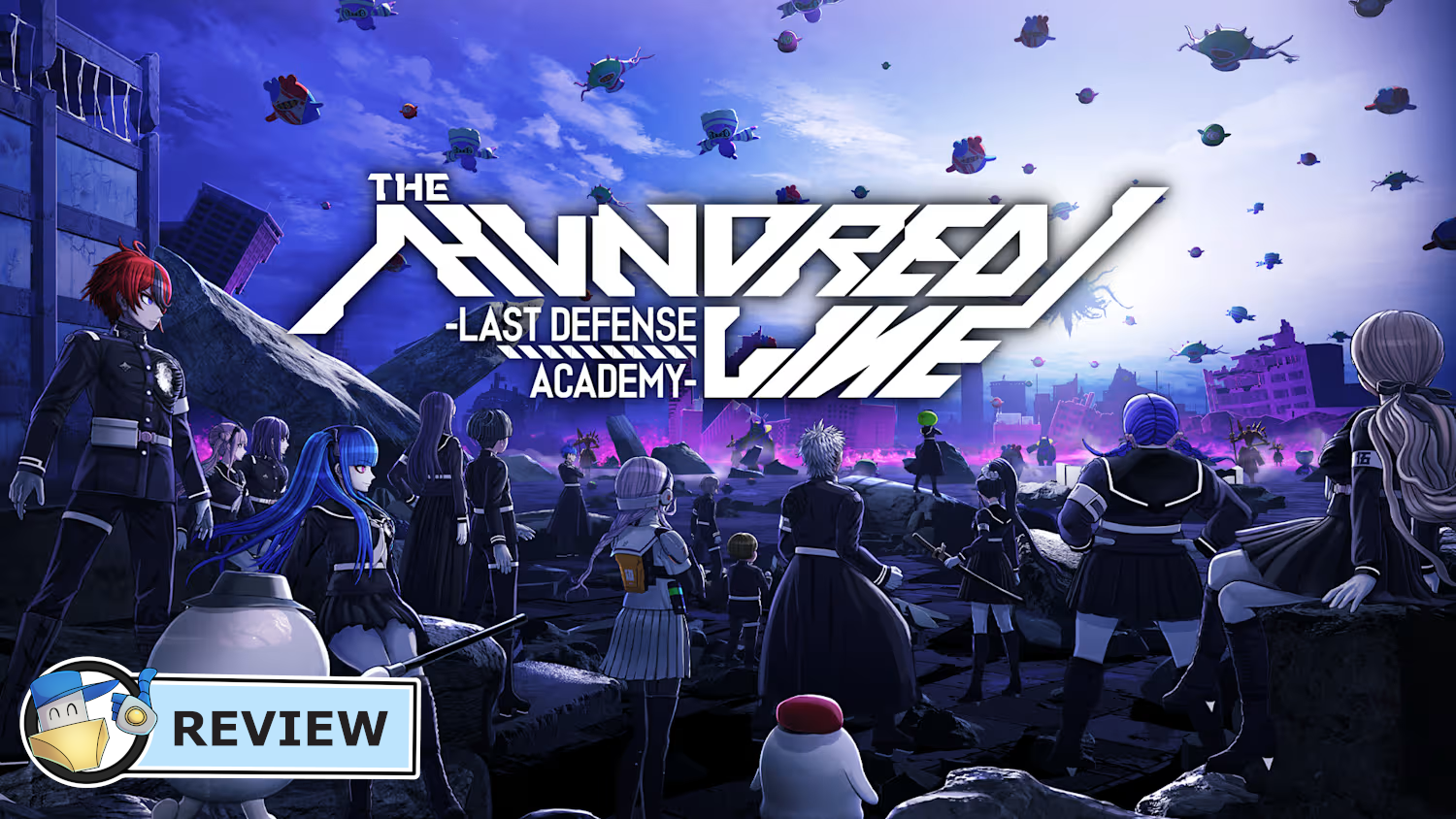
The Hundred Line: Defense Academy is known across JRPG and Visual Novel circles for two things: being written by Kazutaka Kodaka of Danganronpa fame and Kotaro Uchikoshi of the Zero Escape series—both of whose work I am a huge fan of—and featuring one hundred different endings.
While I have yet to see all one hundred endings, a major undertaking that takes around 150–200 hours to complete, I have spent a considerable amount of time with the game. Without going into spoilers, I feel I have finally reached a point where I can properly review the title. That being said, I will definitely go back to obtain the rest of the endings, which alone says plenty about how much I enjoyed the experience.
So, what is The Hundred Line Defense Academy, and is it worth your time?
The Story:

The Hundred Line: Defense Academy, which I will refer to as Defense Academy from now on for the sake of brevity, is a mystery visual novel, first and foremost, and so has a strong emphasis on its story.
The game begins with about a 25-minute animated cutscene that introduces us to our protagonist, Takumi Sumino. It shows his life in the Tokyo Residential Complex, a seemingly man-made place where humanity now lives. It shows us that every once in a while alarms flare up, and everyone is required to go to underground shelters.
It also introduces his childhood friend, Karua, who will be his main motivation throughout the game, in somewhat of a roundabout way.
It ends with monsters attacking the complex and an egg-shaped creature with a hat giving him a strange power that lets him fight those creatures. From there, he is whisked away, waking up in a classroom with several people he's never met before.
This cutscene is unpausable, though skippable, and you don't unlock the ability to even open up the menu for at least a full hour of playtime, even during the visual novel sections that come right after it. Considering I just didn't find the English voices fitting for the characters and wanted to go back to the menus to change them, that was a very noticeable oversight.

In the coming scenes, the purpose is fleshed out: the people there have to fight the weird invaders and survive one hundred days for the sake of humanity. From there, several twists and turns ensue, and we get to learn more about what's going on. For the sake of avoiding spoilers, this is where I will stop describing story events.
The first hundred days follow a standard visual novel style, in which you have one single route. Once beaten, you get to repeat the game with more difficult battles, as well as added choices, which will let you get the different endings of the game.
Defense Academy, while entirely enjoyable on its own, has plenty of callbacks to the writers' previous works; Zero Escape, Danganronpa, and Master Detective Archives: RAIN CODE have references to them time and time again. While it doesn't feel out of place, experiencing them before playing Defense Academy is highly recommended to get the most out of this experience.
Speaking of references, this game is also filled with references to different anime, manga, and games. JoJo, Gurren Lagann, and Persona are just three of the many I managed to notice. While it would've been annoying in the hands of less competent writers, Kodaka and Uchikoshi manage to make them quite enjoyable to catch.
Gameplay:

While visual novel segments are a big part of the gameplay, they are still just a part of a whole; during these segments, you get to talk to other characters, as well as advance the story.
The other segments, though, feature much more varied gameplay.
As you spend your one hundred days in the Academy, your time is divided into three parts: the visual novel segments, which we already discussed, battle segments, which happen on predetermined days, and free time.
Battle segments are the usual affair for those who have played tactical RPGs before: you have units on a grid, each with their own attacks, abilities, and range of movement, and they are up against other units on the same grid, in up to four different fronts. You have a certain amount of Action Points—or AP for short—and when you finish your AP, your turn ends, and the enemies take their turn. Rinse and repeat until the fight is done.
The characters that are available to you are drip-fed to you due to story reasons, and that is very much a good thing. Each character has a completely different role, and can encompass utility that even veterans of the genre might be surprised by. Letting the player pick everyone up right away would've definitely made me feel overwhelmed.

The goal in these fights is usually to either defeat all enemies or defeat a specific, stronger boss enemy. You lose if either your entire team dies or a certain device on the field is destroyed. Fights usually have more than one wave, and when a wave resets, all your units are healed, but the device doesn't have its HP restored, so you have to be careful.
As you defeat enemies, a gauge at the top is charged; it caps at 300%, and you can use it for each 100% to get a useful effect; you can buff a character for the rest of the fight with one of several useful skills, restore one AP, or use a powerful attack with the downside of making the character unable to be used until the end of the next turn.
Eventually, you unlock the ability to use "devices" in the fight—either walls that can stop the enemies until they destroy those walls, or single-use potions that last until the end of the turn and can either buff a character or restore HP.
The free time is where it gets interesting.
During free time, which can happen in the Morning, Afternoon, or both in a single day, you can either bond with or give a gift to a character, which will upgrade one of your five stats, as well as unlock bond scenes once you hit your second playthrough; you can read in the library to also upgrade one of your stats, go exploring, do a fighting simulation, or upgrade your characters or devices.
Fighting in a simulation is pretty much going through a fight with specific characters, which will reward you with much-needed money.

Exploring lets you pick up to three different characters to go with you, and works like a board game; you get two cards, and you choose one each turn to determine how many spaces you move on the grid. You keep the card you didn't choose, and you draw another one for the next. The map has different points of interest, though some have a story-lock, with special items and routes to different such maps.
Through your journey on the boards, as you land on different tiles with symbols on them, you get to choose between different choices; these choices will either give you materials, take materials from you, recover your HP, or cause you to lose HP. Other spaces will get you into a fight, which will reward you with materials based on the map.
Your materials are capped at 9, and once you pass that, for every new material you gain, you have to choose to discard another in order to keep it. I found that number to be way too small for my liking, as trying to unlock treasure each time a story lock unlocked in order to use my time more effectively left me throwing away more than 90% of the materials I managed to get.
Thankfully, the maps also do have checkpoints, which will stop you dead in your tracks and let you either go back, move to a different unlocked checkpoint, or continue exploring. This is the only safe way to finish exploration, as if you lose all your HP during exploration, you also lose half your materials.

It is important to note, though, that if a day has two sections of free time, exploration is the only choice that will use both.
Spending time with characters or giving them gifts, as stated before, will raise one of your stats. A thing the game doesn't tell you, however, is that each stat is divided into two parts; for example, the Gym stat is divided into Endurance and Mobility, and each character is assigned either one or both of those parts. Maxing out both of those is required to max the stat.
While the library is a good way to rank up stats early on, each stat only has two books that give full rewards on the first two reads each, and so it becomes obsolete very quickly; I would've liked more of a use for the library once that's done, rather than it being a one-and-done thing.
Stats, materials, and money are all important, as they are required to upgrade your characters and devices; money and stats are both used when upgrading, but while you can have enough materials to upgrade something, if your stats are not high enough, you will not be able to upgrade it. Thankfully, while upgrading can only be done during free time, it does not take up your free time slot.

That is pretty much the gist of the game; you go through one hundred days in the Academy, and spend your time either going through the story, using your free time to prepare for fights in different ways, or having to fight on specific days.
It's a rather addictive loop, with no one segment really overstaying its welcome. Grinding for the endings is a bit over the top, in my opinion, but thankfully, with the addition of a chapter select that slowly unlocks during your second run, it's not that bad of an undertaking.
However, thanks to this being an RPG game where you have to manage your time in order to keep your characters up to snuff, it is very possible to lock yourself in an unwinnable situation, unlike the previous series, which were either pure visual novels or puzzle games that let you take your time.
There is no real way to truly stop and grind levels at your own pace, and so soft-locking saves, while it didn't happen to me, is something I can seriously see happening to less experienced players.
Should you play it?

The Hundred Line: Defense Academy is honestly a treat for fans of the genre. While not as easy to recommend as the writers' previous works—which are truly deserving of an "Essential" rating—thanks to its incorporation of time management and RPG fights, the characters, twists, and writing quality still make for an incredible visual novel.
If you like visual novels and don't mind RPG gameplay, or vice versa, if you love both genres, or if you simply like the writers' previous works, The Hundred Line: Defense Academy is a game you owe it to yourself to play.
VERDICT: Recommended
Reviewed on PC
Available On: Nintendo Switch, and PC


Post a Comment